

Veličina ovog PNG prikaza ove SVG datoteke: 651 × 600 piksela. Ostale razlučivosti: 261 × 240 piksela | 521 × 480 piksela | 834 × 768 piksela | 1.112 × 1.024 piksela | 2.223 × 2.048 piksela | 1.065 × 981 piksela.


Vidi sliku u punoj veličini (SVG datoteka, nominalno 1.065 × 981 piksela, veličina datoteke: 56 KB)

|
Ova je datoteka sa stranica Zajedničkog poslužitelja Zaklade Wikimedije i smiju je rabiti drugi projekti. Opis s njezine stranice s opisom datoteke prikazan je ispod. |

Sažetak
| Opis |
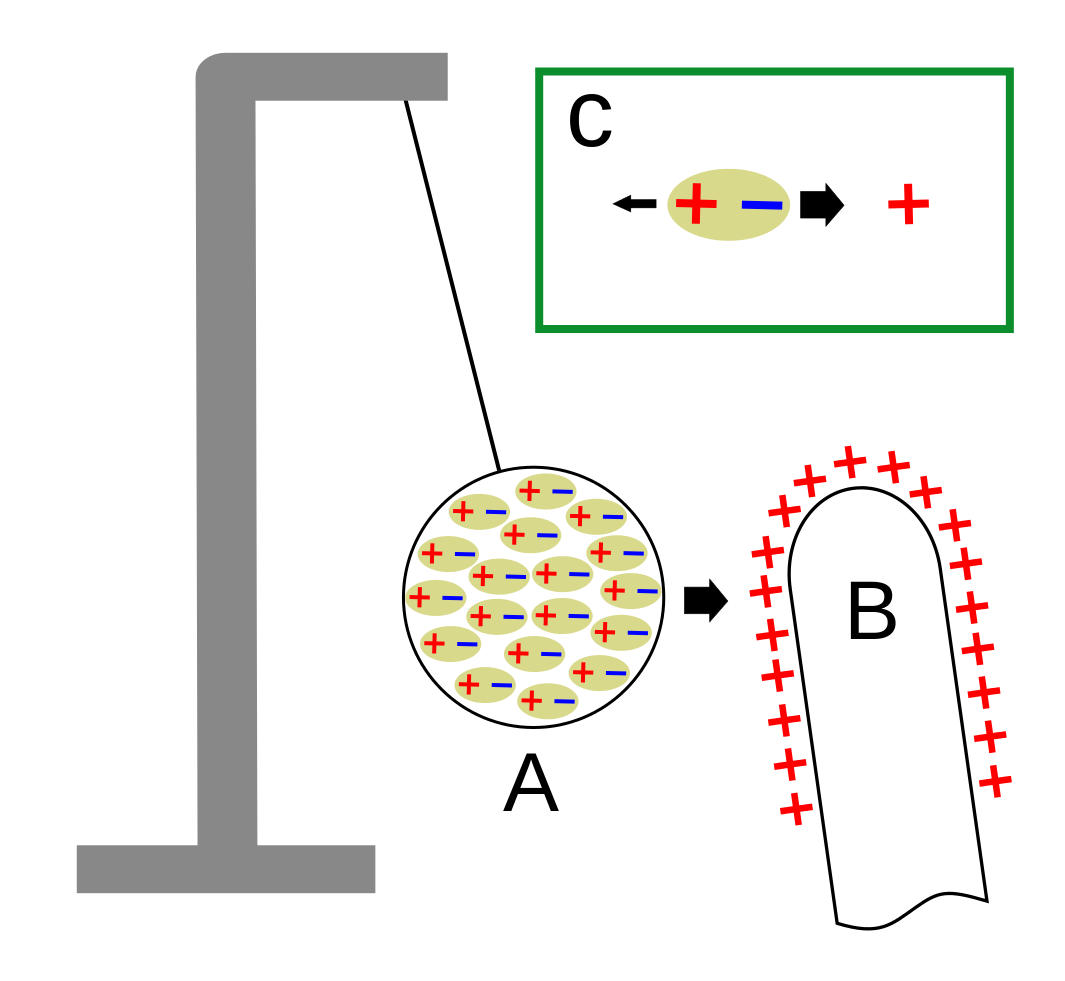
English: Diagram showing how a pith-ball electroscope works. The molecules (yellow ovals) that make up the pith ball (A) consist of positive charges (atomic nuclei) and negative charges (electrons) close together. Bringing a charged object (B) near the pith ball causes these charges to separate slightly. If the object has a positive charge, the electrons ( – ) in the molecules will be attracted to it, and will move to the side of the molecule near the object. The nuclei ( + ) will be repelled and will move to the side of the molecule away from it. This is called polarization. Since the electrons are now closer to the external charge than the nuclei (C) their attraction is stronger than the repulsion of the nuclei, and therefore the result is a weak attractive force. The separation of charges is microscopic, but since there are so many atoms in the pith ball the total force is strong enough to pull the pith ball toward the external charge. |
| Datum | |
| Izvor | Vlastito djelo postavljača |
| Autor | Chetvorno |
Licencija
Ja, nositelj autorskog prava za ovo djelo, ovime ga objavljujem pod sljedećom licencijom:
 
|
Ova datoteka je dostupna pod Creative Commons CC0 univerzalnim odricanjem u javno vlasništvo. |
| Osoba koja je sudjelovala u radu na ovom dokumentu posvetila je rad javnom vlasništvu odricanjem od svih njenih prava na taj rad širom svijeta po zakonom o autorskim pravima i sve povezana zakonska prava koja bi imao/imala, u mjeri dopuštenoj zakonom. Možete kopirati, mijenjati, distribuirati i prilagođavati rad, čak i u komercijalne svrhe, bez traženja dopuštenja.
|
Povijest datoteke
Kliknite na datum/vrijeme kako biste vidjeli datoteku kakva je tada bila.
| Datum/Vrijeme | Minijatura | Dimenzije | Suradnik | Komentar | |
|---|---|---|---|---|---|
| sadašnja | 03:23, 3. listopad 2012. | | 1.065 × 981 (56 KB) | wikimediacommons>Chetvorno | User created page with UploadWizard |
Poveznice
Na ovu sliku vode poveznice sa sljedećih stranica:
