
Vidi sliku u punoj veličini ((1.290 × 1.170 piksela, veličina datoteke: 599 KB, <a href="/wiki/MIME" title="MIME">MIME</a> tip: image/png))

|
Ova je datoteka sa stranica Zajedničkog poslužitelja Zaklade Wikimedije i smiju je rabiti drugi projekti. Opis s njezine stranice s opisom datoteke prikazan je ispod. |
Sažetak

|
Dostupna je vektorska inačica (SVG) ove slike. Trebala bi se koristiti umjesto ove rasterske slike ako je kvalitetnija.
File:Langs N.Amer.png → File:Langs N.Amer.svg
Za više informacija o vektorskoj grafici, pročitajte o prelasku Zajedničkog poslužitelja na SVG. Također pročitajte informacije o podršci MediaWiki softvera slikama u SVG formatu. |
 |
|


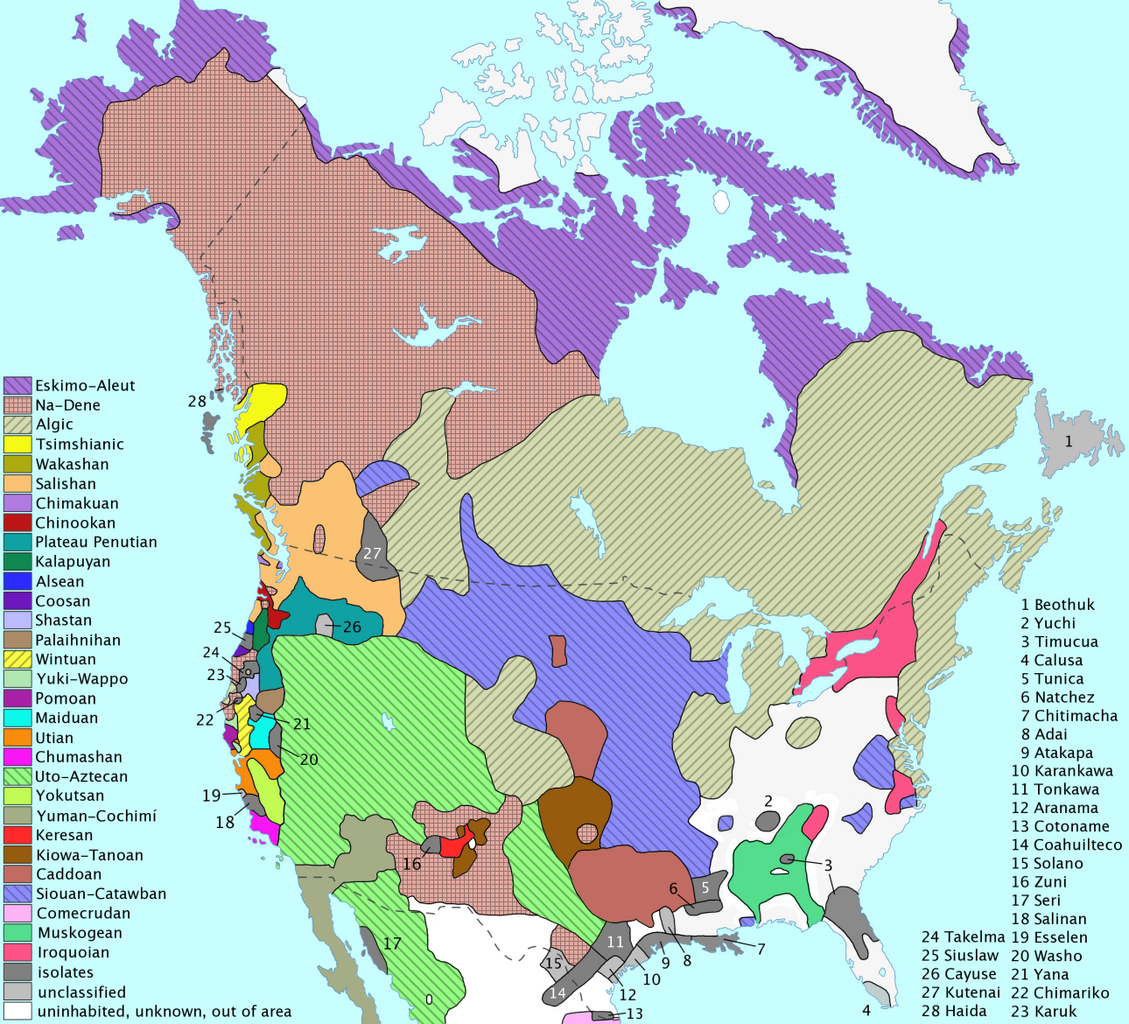

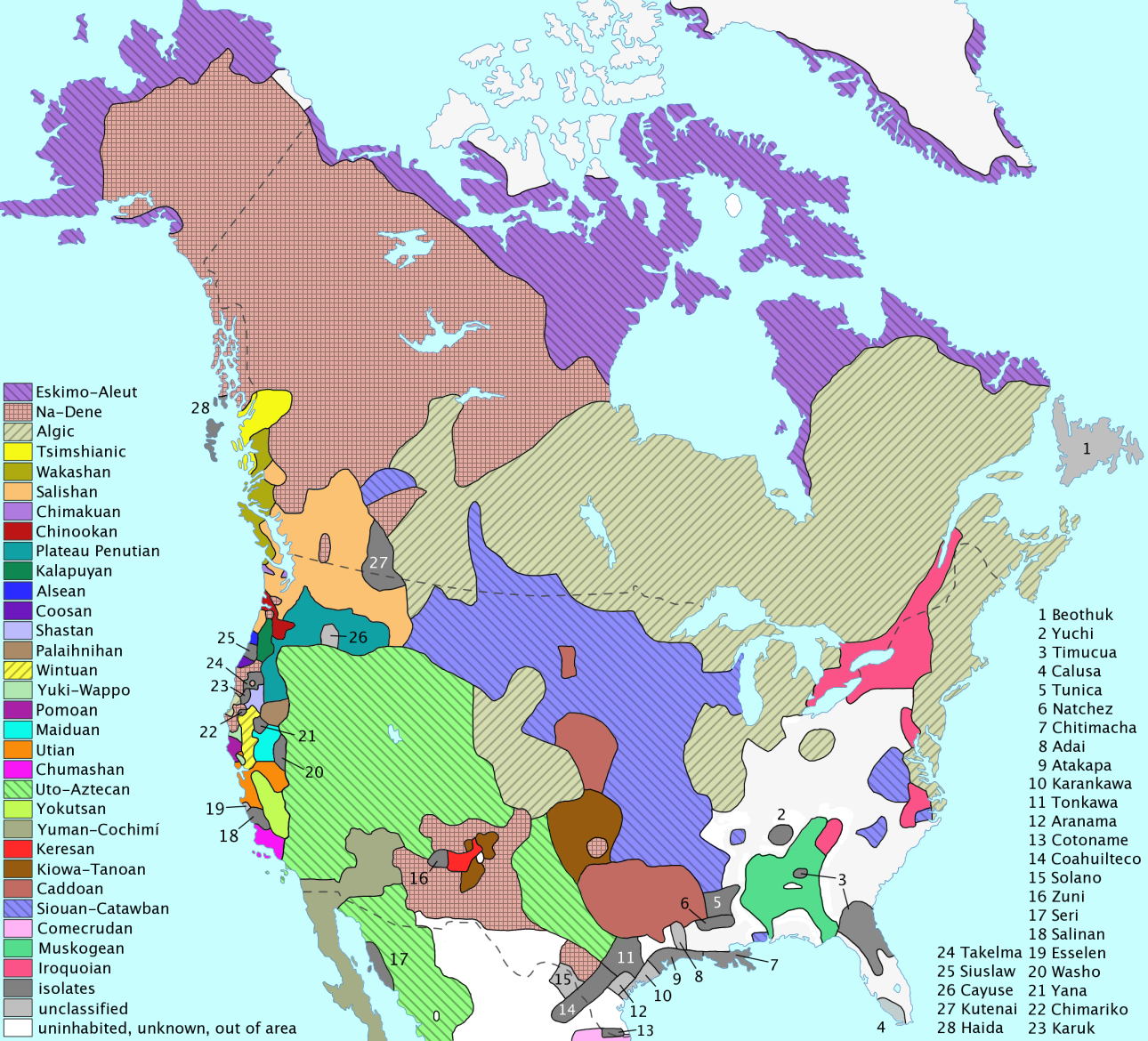
Distribution of North American language families north of Mexico
- Deutsch (German): Image:Langs_N.Amer_Deutsch.png
- español (Spanish): Image:Langs N.Amer espanol.png
- français (French): Image:Langs N.Amer fr.png


Info
- created by en:User:ish ishwar in 2005, using the GIMP software
- released under CC-by-2.0
About sources
Map redrawn and modified primary based on two maps by cartographer Roberta Bloom appearing in Mithun (1999:xviii–xxi). Incidentally, these maps are very derivative of the Driver map of the 1950s–60s (which means that, although published in 1999, it is not as up-to-date as one might think). The other main source used is the up-to-date and very well-done map found in Goddard (1996), which was revised as Goddard (1999). Essentially, Bloom's map was used for the projection and general outline of language borders while Goddard's maps were used to adjust Bloom's borders to reflect the more recent research.
Additional references include Sturtevant (since 1978), Mithun (1999:606–16), and Campbell (1997:353–76). Mithun and Campbell have several maps based on the maps found in Sturtevant (since 1978) and Bright (1992).
Mithun, M. (2001.) The Languages of Native North America, Cambridge Language Surveys, Cambridge University Press ISBN: 978-0-521-29875-9.
About map content
- Map delineates each language family in a unique color.
- Language isolates are all in dark grey, e.g. Chitimacha (#7) is an isolate in Louisiana. This is not meant to imply any relationship among them whatsoever. All isolates are assigned a number and listed on the right side of map.
- Unclassified languages (i.e. #1 Beothuk, #4 Calusa, #8 Adai, #10 Karankawa, #12 Aranama, #15 Solano, #19 Esselen, #26 Cayuse) are in light grey and are also assigned a number and listed with the isolates on the right. (Unclassified languages in the case of North America are unclassified because there is not sufficient data to determine genealogical relationship.)
- Areas in white are either
- uninhabited (in Alaska, Canada, Greenland),
- unknown (due to early extinction and little or no data; this is mostly in the East), or
- outside of subject area (in Mexico). (note that Seri (#17) is included because it is usually considered part of the Southwest culture area and also included in various Hokan phylum proposals.)
- This is a historical map: Although most languages are still spoken in North America, the extent of their distribution has been profoundly affected by European contact — many languages have become extinct (sometimes including even the peoples). (See Endangered language.)
- Language areas are those at earliest time of European contact, as far as can be determined. Since contact occurred at different times in different areas, no historical Native American maps of the entire continent are of a single time period.
- Language areas are not as well-defined as this map would suggest: borders are often fuzzy and arbitrary and the entire language area may not be fully occupied by language speakers.
- Na-Dene here is Athabaskan-Eyak-Tlingit, excluding Haida (#28).
- The following groupings are disputed by some (or are considered not fully demonstrated):
- Plateau Penutian (aka Shahapwailutan) = Klamath-Modoc (isolate) + Molala (isolate) + Sahaptian (family). Sometimes Cayuse (#26) is included in Plateau Penutian, but this language is not very well documented and is now extinct. Thus, it is considered unclassified here.
- Yuki-Wappo = Yuki (isolate) + Wappo (isolate).
To do
- translation into Spanish & other languages
- extend Mexico coverage (for Comecrudo)?
Links
You might want to compare this map with these two older (1967) maps of only the USA:


There is also an Inuktitut dialect map in Wikipedia:

Be sure to check out the beautiful work of Mutur Zikin (www.muturzikin.com):
- Distribution Linguistique Aux Étas-Unis Et Canada (in English, Basque, French, Spanish)
- Distribution Linguistique En Amérique Latine (in English, Basque, French, Spanish)
Looking for more maps of South America? Go here:
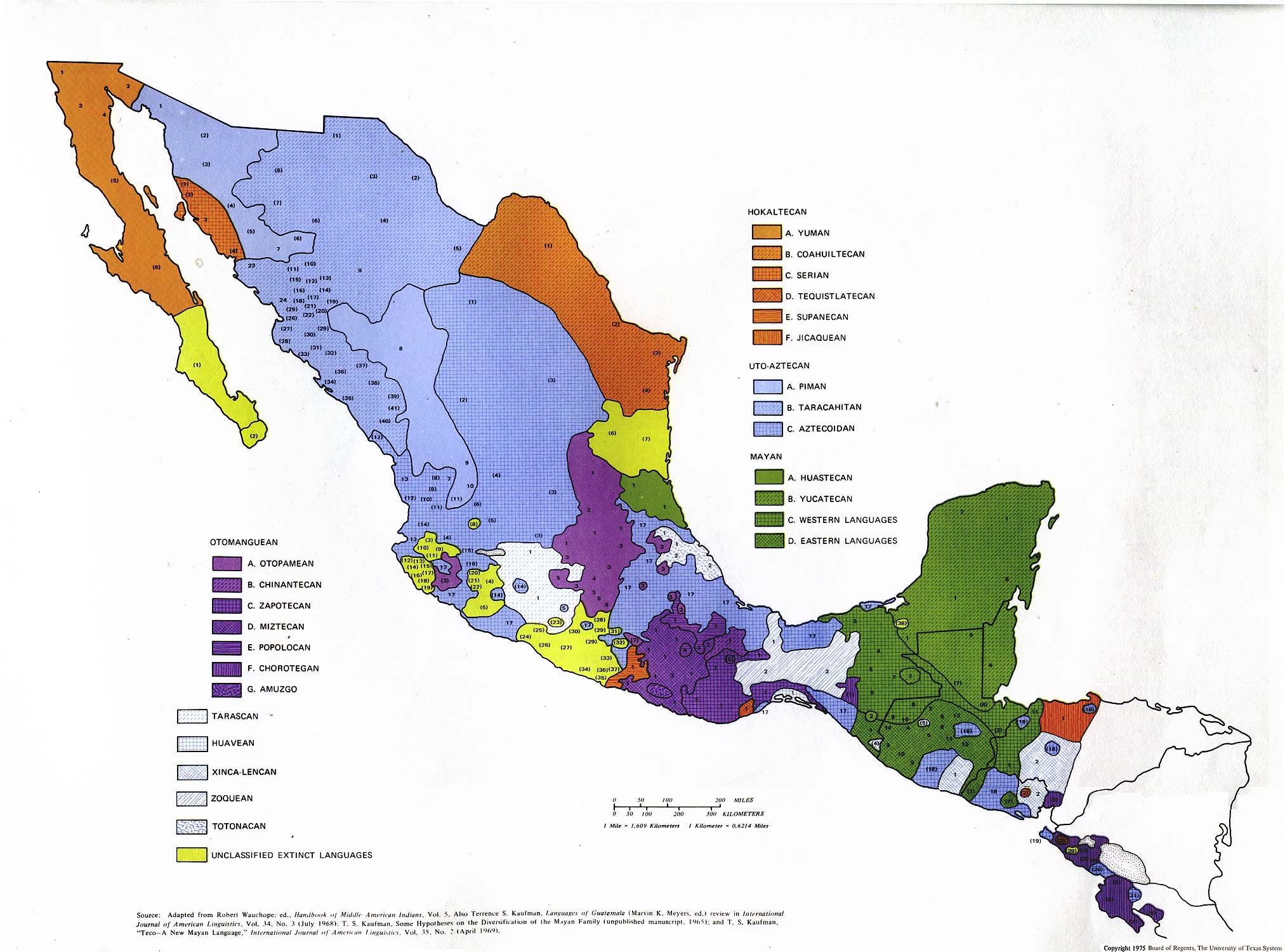
A (older) map of Mexico (provided by the University of Texas):
- Map itself: www.lib.utexas.edu/../aboriginal_map.jpg (in English)
- Text accompanying map: www.lib.utexas.edu/../aboriginal_languages_txt.jpg (in English)

Some pages in Wikipedia:
- Classification schemes for indigenous languages of the Americas (in English)
- Indigenous languages of the Americas (in English)
- Mesoamerican languages (in English)
- Languages of Peru (in English)
- Category: Indigenous languages of the Americas (in English)
- Indigene amerikanische Sprachen (in German)
- Lenguas amerindias (in Spanish)
- Langues amérindiennes (in French)
Some other sites on American languages (in English):
- The Society for the Study of the Indigenous Languages of the Americas
- The Archive of the Indigenous Languages of Latin America archive copy at the
You might also be interesting in:
- the Aboriginal Mapping Network (in English)
Other maps in this series
These other maps of single families are generated from the main map above.
- Adai
- Algic - Algisch - algiques
- Alsean - Alsea - alséannes
- Atakapa
- Beothuk - béothuk
- Cayuse
- Chimakuan
- Chimariko
- Chinookan - Chinook
- Chitimacha
- Chumashan - Chumash
- Coahuilteco
- Cotoname
- Eskimo-Aleut - Eskimo-Aleutisch - eskimo-aléoutes
- Esselen
- Haida
- Karankawa
- Karuk - Karok
- Keresan - Keres
- Kiowa-Tanoan
- Kutenai
- Muskogean - Muskogee
- Na-Dene - na-déné
- Natchez
- Salishan - Salish
- Utian - Uti
- Yokutsan - Yokut - yokuts


Bibliography
- Bright, William (Ed.). (1992). International encyclopedia of linguistics (Vols. 1-4). New York: Oxford University Press.
- Campbell, Lyle. (1997). American Indian languages: The historical linguistics of Native America. New York: Oxford University Press. ISBN 0-19-509427-1.
- Driver, Harold E. (1969). Indians of North America (2nd rev. ed.). Chicago: Chicago University Press. (Original work 1961).
- Goddard, Ives. (1996). Native languages and language families of North America [Map]. In I. Goddard (Ed.), Handbook of North American Indians: Languages (Vol. 17). (W. C. Sturtevant, General Ed.) Washington, D. C.: Smithsonian Institution. ISBN 0-1604-8774-9.
- Goddard, Ives. (1999). Native languages and language families of North America (rev. and enlarged ed. with additions and corrections). [Map]. Lincoln, NE: University of Nebraska Press (Smithsonian Institute). (Updated version of the map in Goddard 1996). ISBN 0-8032-9271-6.
- Krauss, Michael. (1982). Native peoples and languages of Alaska (rev. ed.). [Map]. Fairbanks, AK: Alaska Native Language Center. ISBN 0-933769-00-8.
- Mithun, Marianne. (1999). The languages of Native North America. Cambridge: Cambridge University Press. ISBN 0-521-23228-7 (hbk); ISBN 0-521-29875-X.
- Powell, John W. (1891). Indian linguistic families of America north of Mexico. Seventh annual report, Bureau of American Ethnology (pp. 1-142). Washington, D.C.: Government Printing Office. (Reprinted in P. Holder (Ed.), 1966, Introduction to Handbook of American Indian languages by Franz Boas and Indian linguistic families of America, north of Mexico, by J. W. Powell, Lincoln: University of Nebraska).
- Sebeok, Thomas Albert (Ed.). (1973). Current trends in linguistics: Linguistics in North America (Vol. 10, Pts. 1-2). The Hague: Mouton.
- Sturtevant, William C. (Ed.). (1978-present). Handbook of North American Indians (Vols. 1-20). Washington, D. C.: Smithsonian Institution. (Vols. 1-3, 16, 18-20 not yet published).
Thank You
Thanks goes to:
- User:Mark Dingemanse for creating his lingustic maps of Africa which inspired me to create this one
- en:User:Wapcaplet for helpful suggestions concerning form
- User:Vlad2i for kindly providing the Français translation
- de:Benutzer:Napa for kindly providing the Deutsch translation
- en:User:kwamikagami for helpful suggestions concerning classification, content, and form
- en:User:Deglr6328 for helpful suggestions concerning accessibility issues involving viewers with color blindness
Licencija


- Slobodno smijete:
- dijeliti – umnožavati, distribuirati i javnosti priopćavati djelo
- remiksirati – prerađivati djelo
- Pod sljedećim uvjetima:
- imenovanje autora – Morate pripisati odgovarajuće autorske zasluge, dati poveznicu na licenciju, te naznačiti jesu li načinjene promjene autorskog djela. Prethodno navedeno možete učiniti na svaki razuman način, ali ne na način koji bi sugerirao da Vi ili Vaše korištenje licencorova djela ima izravno licencorovo odobrenje.
Povijest datoteke
Kliknite na datum/vrijeme kako biste vidjeli datoteku kakva je tada bila.
| Datum/Vrijeme | Minijatura | Dimenzije | Suradnik | Komentar | |
|---|---|---|---|---|---|
| sadašnja | 17:28, 20. srpanj 2019. | | 1.290 × 1.170 (599 KB) | wikimediacommons>Denniss | Reverted to version as of 21:52, 1 March 2009 (UTC) |
Poveznice
Na ovu sliku vode poveznice sa sljedećih stranica:
