

Veličina ovog prikaza: 800 × 395 piksela. Ostale razlučivosti: 320 × 158 piksela | 640 × 316 piksela | 1.265 × 625 piksela.
Vidi sliku u punoj veličini ((1.265 × 625 piksela, veličina datoteke: 58 KB, <a href="/wiki/MIME" title="MIME">MIME</a> tip: image/png))

|
Ova je datoteka sa stranica Zajedničkog poslužitelja Zaklade Wikimedije i smiju je rabiti drugi projekti. Opis s njezine stranice s opisom datoteke prikazan je ispod. |

|
This map of the world image could be re-created using vector graphics as an SVG file. This has several advantages; see Commons:Media for cleanup for more information. If an SVG form of this image is available, please upload it and afterwards replace this template with
{{vector version available|new image name}}.It is recommended to name the SVG file “Clash of Civilizations map.svg”—then the template Vector version available (or Vva) does not need the new image name parameter. |
Sažetak
| Opis |
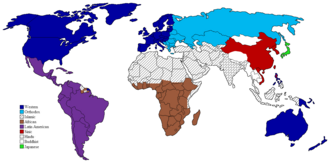
English: "The World of Civilizations: Post-1990", map from Huntington's Clash of Civilizations (1996) indicating the postulated world's nine major "civilizations": Western, Latin American, Orthodox, Islamic, Sinic, Buddhist, Japanese, Hindu, African.
|
| Datum | 1996; 17. svibnja 2007. (izvorni datum postavljanja) |
| Izvor |
The informational source of the map is the original map of the book. (p. 26) scan of original map.
This image by en:User:Kyle Cronan, based on previous (GFDL) version of image, from en.wikipedia; description page is/was here. Transfer was stated to be made by User:Multichill. |
| Autor | Kyle Cronan na Wikipediji na engleskom jeziku |
| Ostale inačice |
 |




![[1]](http://europelostandfound.net/files/elf/images/Clash_of_Civilizations_world_map.png)
![[2]](http://www.iranreview.org/file/cms/files/2(4).png)
![[3]](http://www.net4you.com/jandlftp/clash-bild.jpg)
![[4]](http://library.buffalo.edu/libraries/asl/maps/img/civ_21st_century_lrg.jpg)
![[5]](http://2.bp.blogspot.com/_wzY_y6FoTH4/TJO9mokWCbI/AAAAAAAAAXU/ddKcn3JSg58/s1600/Carte+des+civilisations+selon+Huntington.jpg)
![[6]](http://www.ladocumentationfrancaise.fr/var/ezflow_site/storage/images/docfr7/cartes/organisations-et-relations-internationales/c001176-le-choc-des-civilisations-selon-samuel-huntington/454325-6-fre-FR/Le-choc-des-civilisations-selon-Samuel-Huntington_large_carte.jpg)

Licencija
Kyle Cronan at the English Wikipedia, nositelj autorskog prava za ovo djelo, ovime ga objavljuje pod sljedećom licencijom:

|
Dozvoljava se umnožavanje, dijeljenje i/ili mijenjanje ovog dokumenta pod uvjetima GNU-ove licence za slobodnu dokumentaciju, inačica 1.2 ili kasnija ako ju je objavio Free Software Foundation; bez nepromjenjivih ili obveznih dijelova i bez teksta na naslovnoj i/ili posljednjoj stranici. Kopija licencije je uključena u odjeljak naslovljen GNU-ove licence za slobodnu dokumentaciju. |
  
|
Ova datoteka je licencirana pod Creative Commons Imenovanje-Dijeli pod istim uvjetima 3.0 nelokaliziranom licencijom. | |
Autor:
Kyle Cronan at the English Wikipedia | ||
| ||
| Ova oznaka za licenciranje dodana je datoteci kao dio GFDL ažuriranja licnciranja. |
Izvorna evidencija postavljanja
(All user names refer to en.wikipedia)
- 2007-05-17 04:56 Kyle Cronan 1350×625×8 (44292 bytes) Self-made by [[User:Kyle Cronan]], based on previous (GFDL) version of image.
Povijest datoteke
Kliknite na datum/vrijeme kako biste vidjeli datoteku kakva je tada bila.
| Datum/Vrijeme | Minijatura | Dimenzije | Suradnik | Komentar | |
|---|---|---|---|---|---|
| sadašnja | 19:51, 27. srpanj 2021. | | 1.265 × 625 (58 KB) | wikimediacommons>Vannura | Fixed the Djibouti area. |
Poveznice
Na ovu sliku vode poveznice sa sljedećih stranica:
