
Central_Asian_Buddhist_Monks.jpeg ((470 × 591 piksela, veličina datoteke: 173 KB, <a href="/wiki/MIME" title="MIME">MIME</a> tip: image/jpeg))

|
Ova je datoteka sa stranica Zajedničkog poslužitelja Zaklade Wikimedije i smiju je rabiti drugi projekti. Opis s njezine stranice s opisom datoteke prikazan je ispod. |
Sažetak
| Opis |
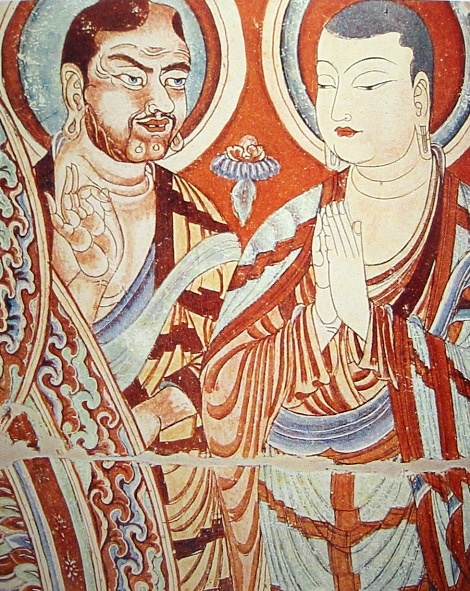
A Caucasian Central Asian monk, possibly an Indo-European Sogdian or Tocharian, teaching an East Asian monk, perhaps a Turkic Uyghur or Chinese, on a 9th-century AD fresco from the Bezeklik Thousand Buddha Caves near Turfan, Xinjiang, China. A detail from Praņidhi scene no. 5 in Temple no. 9. The book that this painting is reproduced in has full descriptions of these two figures. Relevant details, along with the German descriptions, are found below.
In "Tafel 19" of his Chotscho: Facsimile Reproduction of Important Findings of the First Royal Prussian Expedition to Turfan in East Turkistan] (Berlin, 1913), Albert von le Coq identified the figure on the right as a "Tocharer" (i.e. Tocharian) and the figure on the left as "Ostasiate" (i.e. East Asian). In other murals of the Bezeklik Budda Caves, however, foreign-looking Caucasian men have been identified as ethnic Sogdians (an Eastern Iranian people). For instance, Scene No. 6 in Temple 9, in the same temple as the aforesaid mural, modern scholars have identified the kneeling men draped in silk robes as Sogdians (see Gasparini, Mariachiara. "A Mathematic Expression of Art: Sino-Iranian and Uighur Textile Interactions and the Turfan Textile Collection in Berlin," in Rudolf G. Wagner and Monica Juneja (eds), Transcultural Studies, Ruprecht-Karls Universität Heidelberg, No 1 (2014), pp 134-163. ISSN: 2191-6411. See also endnote #32 for further information on source material.) |
| Datum | 8. stoljeće |
| Izvor | Chotscho: Facsimile Reproduction of Important Findings of the First Royal Prussian Expedition to Turfan in East Turkistan, Berlin, 1913. A catalogue of the findings of the Second German Turfan Expedition (1904–1905) led by Albert von Le Coq, containing colour reproductions of the murals, which were destroyed in WW2. (National Institute of Informatics – Digital Silk Road Project Digital Archive of Toyo Bunko Rare Books) |
| Autor | of the paintings - Unknown. Of the book, Albert von Le Coq. |
| Ostale inačice |


|
Ovo je vjerna fotografska reprodukcija dvodimenzionalnog umjetničkog djela koje je u javnom vlasništvu. Samo umjetničko djelo u javnom je vlasništvu zbog sljedećeg razloga:
Službeni stav Zaklade Wikimedia jest da su "vjerne reprodukcije dvodimenzionalnih djela u javnom vlasništvu".
Stoga se i ova fotografska reprodukcija smatra javnim vlasništvom u Sjedinjenim Američkim Državama. U drugim zemljama ponovna uporaba ovog sadržaja može biti ograničena; pojedinosti možete vidjeti na stranici Reuse of PD-Art photographs. | ||||


Povijest datoteke
Kliknite na datum/vrijeme kako biste vidjeli datoteku kakva je tada bila.
| Datum/Vrijeme | Minijatura | Dimenzije | Suradnik | Komentar | |
|---|---|---|---|---|---|
| sadašnja | 12:25, 27. ožujak 2005. | | 470 × 591 (173 KB) | wikimediacommons>Beta m common | 9th century fresco from Bezeklilk, Tarim Basin. {{PD-art}} |
